
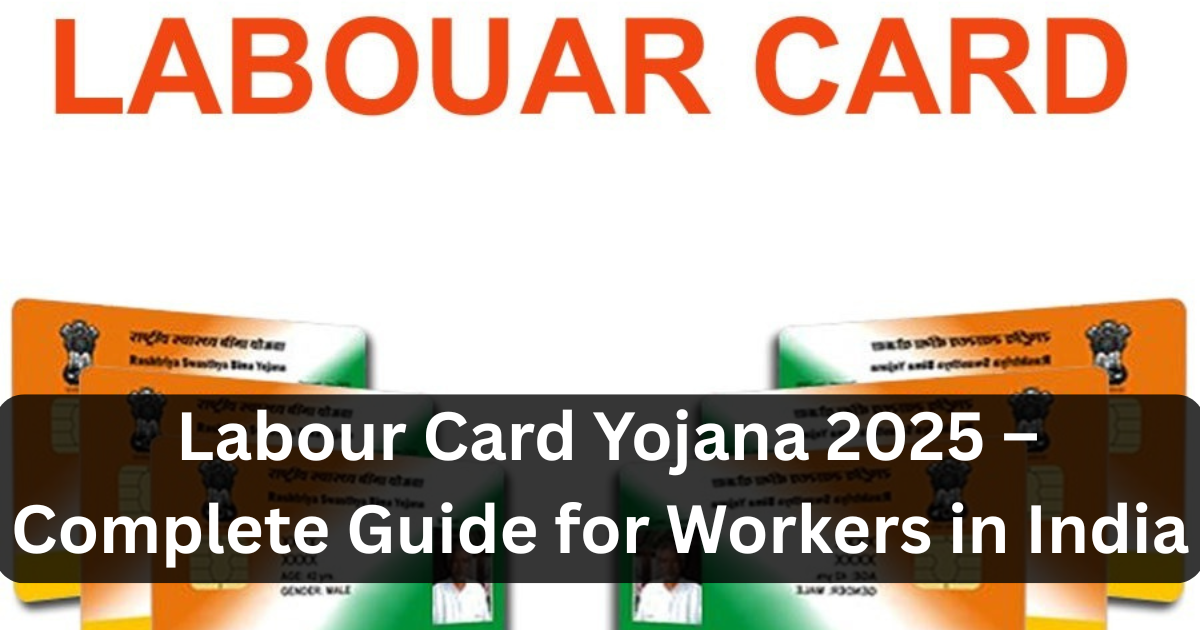
In India, workers in the unorganised sector — such as daily-wage labourers, construction workers, agricultural labourers, domestic helpers and others — often face vulnerabilities such as lack of formal registration, limited access to welfare schemes and weak social security cover. To address these issues, various state governments and the central government have introduced what is commonly called a Labour Card (or labour registration card) under different labour-welfare statutes and labour departments. A “labour card” serves as an identity and registration of a worker, enabling access to welfare benefits, social security schemes, financial assistance and recognition of employment status. BankBazaar+2ruralduniya.com+2
In 2025, the “Labour Card Yojana” concept continues to gain importance: states are expanding registration, streamlining processes, and integrating with other platforms such as eSh ram (the national database for unorganised sector workers). For example, the portal of the Delhi Building & Other Construction Workers‑Welfare Board (DBOCWWB) mentions labour card registration for construction workers in Delhi. ClearTax
This article provides a comprehensive, structured overview of Labour Card Yojana 2025: its objectives, components, eligibility criteria, benefits, application processes (online and offline), documents required, progress data, challenges, future goals, frequently asked questions (FAQs) and a conclusion.
Objectives
The main objectives of a labour card system under worker-welfare are:
- To bring workers in unorganised sectors (construction, agriculture, domestic work, contract labour, etc.) into a formal registration system, thereby recognising their work status and enabling access to benefits.
- To provide an identity card and registration that enables inclusion in welfare schemes, insurance, pensions, financial assistance, skill development and other support services. BankBazaar+1
- To ensure better social security coverage for vulnerable workers — e.g., access to health insurance, maternity benefits, death/disability benefits, pension for older age — by verifying that they are registered labourers. BankBazaar
- To facilitate data collection by central and state governments regarding unorganised workers, their sectors, their locations and their needs — thereby helping policymaking, planning and coordination. For example, the national portal eShram attempts to create such a database. eshram.gov.in+1
- To improve transparency, enforcement of labour laws, benefit disbursement, monitoring and renewal of worker registration.
- To help workers avoid exploitation and ensure they are not excluded from welfare simply due to absence of formal registration.
In short, the labour card system acts as a gateway for unorganised workers to access the benefits and protections they are entitled to, and supports the governance framework of labour welfare in India.
Components / What the Labour Card Covers
While specific details vary by state, the labour card welfare system generally includes the following components:
- Registration of Worker
- The primary component is registration of the worker with the state labour department or board (for example, construction workers welfare board) through a labour card or identity card.
- The labour card typically includes the worker’s name, Aadhaar number, bank account details, type of work, employer (if applicable), sector (construction, agriculture, domestic, contract labour) and family details. BankBazaar+1
- There are often categories: e.g., “building card” (for construction sector) and “social card” (for other types of unorganised work) as noted in many states. BankBazaar+1
- Benefit Entitlement & Welfare Schemes Access
- Once registered, the worker becomes eligible for various welfare schemes under the relevant labour welfare board or department — e.g., health insurance, pension, maternity benefit, death benefit, marriage assistance for children, education assistance for dependents. BankBazaar+1
- Construction workers’ welfare boards, for instance, list benefits like pension after age 60, disability pension, ex-gratia for death due to accident, loans for tools, etc. bocw.delhi.gov.in
- Identification and Proof of Worker Status
- The labour card functions as proof that the person is a registered worker; this helps avoid exclusion from schemes that require proof of worker status. For example, it may be needed to claim benefits under the Building & Other Construction Workers (BOCW) Act. ClearTax+1
- Data & Monitoring Module
- The registration and issuance of cards feed into databases (state labour portals / central portals like eShram) which help monitor how many workers are registered, from which sectors, how many have availed benefits, etc. This supports better policy and governance. eshram.gov.in+1
- Renewal / Update / Verification
- The labour card may need periodic renewal or update (e.g., annual membership, proof of work completed, change of sector or employer) depending on state rules. It also may involve verification of documents and work records. BankBazaar
- Integration with Other Schemes
- The labour card and registration often integrate with other social security or welfare schemes — for example, linking with pension schemes (such as the Pradhan Mantri Shyam Yogi Maandhan Yojana), insurance, skill development initiatives, etc. The existence of registration makes these linkages easier.
These are the major components. Implementation details (eligibility thresholds, categories of workers, fee, renewal norms) vary across states.
Eligibility
Eligibility criteria for obtaining a labour card vary somewhat by state and sector; the following covers general norms and then examples.
General Eligibility Criteria
- The applicant should belong to the unorganised sector of work (construction worker, contract labourer, daily-wage worker, agricultural labourer, domestic helper, self-employed in unorganised sector) as defined by the state labour department. BankBazaar+1
- The applicant must hold Indian citizenship and reside in the state/UT where they are applying. For example, in Delhi the applicant must be a resident of Delhi. ClearTax
- Minimum age: often 18 years. Some states impose an upper age limit (for registration) like 60 years for certain benefits. For example, in Bihar the range is 18-60 years. BankBazaar
- The applicant should not hold a permanent house (in some categories) or be already covered under similar welfare registration (depending on scheme specifics).
- The applicant should provide proof of the type of work/employment (for example, having worked in building/construction for a certain number of days, or being registered as a labourer with the district office). For construction worker cards, there is often a minimum number of days of work in preceding year. ClearTax
Example: Delhi Labour Card (Construction Sector)
- Age between 18-60 years. ClearTax
- Worker must have served the Board for at least 90 days in a given year (construction-sector building workers). ClearTax
- The applicant must be a resident of Delhi and hold Aadhaar card. ClearTax
Example: Bihar Labour Card
- Age 18 to 60 years. BankBazaar
- Must be registered as a labourer with the District Labour Office. BankBazaar
- Must be a resident of Bihar. BankBazaar
Because the labour card is essentially a worker-registration tool, applicants should check the exact criteria for their state/sector (e.g., building vs non-building, agricultural vs construction). The central government portal acknowledges variations between states. BankBazaar
Benefits
Holding a labour card brings a number of direct and indirect benefits for workers. These benefits vary by state and sector, but some common ones include:
- Proof of identity and work status: The labour card serves as official proof of worker status, which simplifies access to welfare schemes, insurance claims, skill-training, employment opportunities, housing assistance etc. ClearTax+1
- Access to welfare schemes & social security: Registered workers can avail benefits such as:
- Pension after a specified age (e.g., pension of ₹ 3,000/month after age 60 in Delhi for construction workers). ClearTax+1
- Disability pension or ex-gratia in case of accident or permanent disability. bocw.delhi.gov.in+1
- Death benefit or family pension for dependents in case of death of the registered worker. bocw.delhi.gov.in
- Marriage assistance for children of registered workers (both male/female children) under construction-workers welfare boards. bocw.delhi.gov.in
- Maternity benefits for registered women workers or wives of male registered workers. bocw.delhi.gov.in
- Health care assistance, hospitalisation benefits for construction workers. bocw.delhi.gov.in
- Loans or advances for tools, house-construction for registered workers in some welfare boards. bocw.delhi.gov.in
- Integration with central database / portals: Labour cards often link the worker to national schemes and databases (such as eShram). This can provide further benefits like skill-training, job-matching, and inclusion in government-welfare tracking. eshram.gov.in+1
- Better eligibility for other schemes: Many government schemes require proof of worker status in the unorganised sector; having a labour card simplifies eligibility.
- Enabling formal recognition and rights: For example, registered workers may be better able to enforce labour rights, access grievance redressal, and benefit from welfare boards’ services.
- State-specific incentives: Some states provide specific financial assistance for education of children of cardholders, subsidies, or special allowances. (For example: Bihar labour card benefits list includes “free health insurance, child birth assistance, daughter’s marriage financial help.”) BankBazaar
Overall, the labour card is an enabling tool — it by itself is not a benefit scheme, but unlocks access to benefits. Hence, workers are strongly advised to register and ensure their card details are up-to-date.
Application Process
The application process for obtaining or renewing a labour card differs slightly across states. Generally, it supports both online and offline modes. Below is a typical process covering both.
Online Application
- Visit the official website of your state’s labour department or the board (for example, construction workers welfare board) where labour card registration is available. Some states publicise the “Labour Card / Labour Registration” link. BankBazaar+1
- On the portal, find the “New Registration” or “Labour Card Application” link.
- Choose your district, worker-category (construction / building / non-building / agricultural) and fill in required details such as: name, Aadhaar number, mobile number, address, employment records, bank account number and family details. BankBazaar
- Upload scanned copies of required documents (see next section) — e.g., Aadhaar, photo, address proof, work certificate or employer certificate.
- Submit the form. On successful submission, you will receive a reference/application number or login credentials.
- The labour department or board verifies your submitted data (may verify Aadhaar, bank account, employment record, etc).
- Once approved, the labour card is issued. You may receive downloadable PDF or physical card; some states provide membership number, card number and also list you in online beneficiary registers.
- After issuance, you may check status via the portal (via application number / Aadhaar). For example, in Delhi you can check list of registered workers through the portal. ClearTax+1
Offline Application
- Visit the local Labour Office / Construction Workers Welfare Board / District Labour Office in your area.
- Obtain the “Labour Card Application Form” or worker-registration form from the office (or sometimes available for download online).
- Fill in the form: personal details, Aadhaar number, category of work, employer details (if any), bank account, address, and declarations.
- Attach self-attested copies of the required documents (see next section).
- Submit the form at the office along with documents. In some states you may have to pay a small registration fee.
- Once submitted, the office verifies the information (may conduct site visit, verify employment record).
- On successful verification, the labour card / registration certificate is issued (physical card, membership number or online listing).
- Collect the card or print the certificate; retain reference number. Some states allow subsequent renewal/updates offline too.
Renewal / Update Process
- In many states, labour cards or registrations need periodic renewal (for example annually or every few years) – you may have to submit updated employment/work details. BankBazaar
- If you change address, employer, sector or bank account, you may need to update the registration details online/offline.
- Keep the membership number, login credentials (in case you used online portal) and monitor your status.
Tips for Applicants
- Make sure your Aadhaar is linked with your bank account and mobile number (for easier verification).
- Ensure your bank account is in your own name and valid for direct benefit transfer (if benefits are to be disbursed).
- Prepare employment/work certificates (for construction workers, proof of days worked under contractor) if required.
- Retain photograph, scanned documents and copies of the submitted form/reference number.
- After registration, check the portal periodically for status updates and ensure your name appears in beneficiary list if applicable.
- In case of delay or rejection, contact your local labour office/board to clarify missing information.
Documents Required
The documents required to apply for a labour card will vary by state and category of worker. Below is a general list of commonly required documents:
- Aadhaar card (applicant) and sometimes Aadhaar of family members. BankBazaar+1
- Proof of residence/address (ration card, utility bill, voter ID, bank statement)
- Bank account details (passbook copy or cancelled cheque) with applicant’s name. BankBazaar
- Recent passport-size photograph of applicant
- Work certificate/employer certificate (for workers in construction/building sector you may need proof of working under a registered contractor for a minimum number of days) — e.g., for Delhi labour card: “served Board for at least 90 days in a given year”. ClearTax
- Ration card or family-ID (in some states optional)
- Copy of labour registration form (filled and signed)
- For renewal: previous labour card/registration certificate
- In some states, age proof (if category has age limits)
- Other state-specific certificates: e.g., minimum work period certificate, self-employment proof if working in non-building sector, sector-specific registration.
- Mobile number, email ID (if applying online)
Applicants should check the official state labour department website to get the exact updated list of required documents and format.
Progress Data and Implementation Status
The labour card/worker registration systems are being widely adopted across states. Some indicative information:
- The national portal eSh ram (under the Ministry of Labour & Employment) aims to register unorganised workers and create a national database. eshram.gov.in+1
- Example: The Delhi building workers’ welfare board (DBOCWWB) publishes welfare-scheme benefits linked to registered labour card holders. bocw.delhi.gov.in+1
- Example: In Bihar, the Labour Card 2025 page reports that labour cards enable workers to avail various benefits like health insurance, age/sector eligibility such as building vs social cards, etc. BankBazaar
Because of differences in states and sectors, comprehensive national level data on number of labour cards issued in 2025 is not uniformly published here. However, the adoption trend indicates growing registration, integration with other portals, increasing worker-welfare benefits linked to cards, and state efforts to expand coverage.
For more precise state-wise numbers and annual progress, workers should refer to the annual report of their state labour department or the welfare board concerned.
Challenges
Despite the clear advantages of labour card systems, several challenges persist in implementation:
- Awareness and reach: Many unorganised sector workers are unaware of the registration requirement or the existence of a labour card. Outreach in remote towns/villages is limited.
- Work-proof verification: For sectors like construction, verifying minimum work days or contractor certificates is difficult. Many workers are informal, transient, and documents are missing or inaccurate.
- State-wise variation: The eligibility, benefits, renewal norms, fees, categories (building vs non-building) differ across states; this creates confusion for workers migrating across states.
- Integration with benefits: Even after obtaining a labour card, access to welfare-schemes may be delayed, monitoring may be weak, and linkages (bank account, Aadhaar, benefit disbursement) may not be fully functional.
- Data integrity and duplication: Ensuring uniqueness of registrations, preventing duplicate cards, maintaining updated databases (change of address, sector, employer) is a challenge.
- Renewal / update burden: Workers often have to submit fresh evidence, proof of work, attend offices; the process may be cumbersome and discourage renewal.
- Financial resource constraints: Welfare boards may face budget constraints, which restrict benefit disbursement even for registered workers.
- Migration & portability: Many unorganised workers migrate across states; the labour card issued in one state may not be recognised in another, limiting portability of benefits.
- Linkage with other schemes and technology: While portals exist (e.g., eShram), integration of state labour card databases with central portals is variable; the technology infrastructure in many ULBs/districts remains weak.
Addressing these challenges will be crucial to ensure that labour card registration translates into real welfare and social security for workers.
Future Goals and Way Forward
To maximise the potential of the labour card system, the following are key future goals and recommended directions:
- Increase registration coverage: Especially in remote areas, among migrant labourers, informal sectors (domestic workers, small-hotels, home-based workers) who are under-registered.
- Uniform standards / portability: Develop common minimum criteria for labour cards across states, and ensure portability of the card and associated benefits when workers move between states.
- Full integration with national databases: Harmonise state labour-card systems with national databases like eShram so that workers’ data can be used for additional schemes, training, employment matching, benefits.
- Simplified renewal/update process: Use digital means (mobile apps, self-service kiosks, biometric verification) for renewal, updates and benefit linkages to reduce hassle for workers.
- Transparent benefit delivery: Use direct-benefit-transfer, geo-tagging, dashboard monitoring so workers easily access welfare once registered.
- Better communication and awareness: Extensive awareness campaigns (via labour unions, NGOs, public service announcements) to ensure workers know about labour cards, how to apply and the benefits.
- Sector-specific modules: Expand labour card coverage to more sectors of the unorganised economy (artisans, domestic workers, street vendors) and tailor benefits to their needs.
- Data-driven policy: Use registration data to analyse sectors, labour flows, worker vulnerabilities and design targeted interventions (skill training, health insurance, retirement benefits).
- Link with skill, welfare and job schemes: Use labour card registration as entry point for skill development programmes, placement services, social security schemes and livelihood enhancement.
- Address migration and portability issues: Create inter-state agreements so labour card benefits travel with the worker, and ensure migrant workers are not excluded.
By pursuing these goals, the labour card system can become a strong pillar in India’s effort to formalise unorganised sector work, improve worker welfare, and build inclusive economic growth.
Frequently Asked Questions (FAQs)
Q1. What is a labour card (Labour Card Yojana) in India?
A: A labour card is a registration and identity card issued by the state government’s labour department or workers’ welfare board for unorganised sector workers (construction, contract labour, agricultural labour, domestic helpers, etc). It recognises them as registered workers, gives proof of their status and makes them eligible for welfare benefits. BankBazaar+1
Q2. Who is eligible to apply for a labour card?
A: Generally, Indian citizens working in the unorganised sector, aged 18 years and above, residing in the relevant state/UT, and meeting specified sector/work-period criteria (e.g., days worked under contractor) can register. For example, in Bihar the age range is 18–60 years, and registration with district labour office is required. BankBazaar
Q3. What are the benefits of holding a labour card?
A: Benefits include access to welfare schemes (health insurance, pension, death/disability benefits, marriage/education assistance), proof of worker status, better eligibility for government schemes, integration with national portals, and recognition of work history. bocw.delhi.gov.in
Q4. How can I apply for a labour card?
A: You can apply either online via your state labour department’s portal (filling form, uploading documents, verifying Aadhaar) or offline at your local labour office/board by submitting a filled application form with supporting documents. Example online steps are listed for Bihar. BankBazaar+1
Q5. What documents are required?
A: Commonly required documents include Aadhaar card, bank account details, photograph, proof of residence, work certificate/employer certificate (for sectors requiring it), age proof, and previous registration certificate (for renewal). Applicants should check their state’s specific list. BankBazaar
Q6. Is the labour card valid across states?
A: Not necessarily. Registration is typically state-specific and managed by that state’s labour department or welfare board. Migrant workers moving to another state may need to register there. Efforts to make portability and inter-state recognition are ongoing.
Q7. How often do I have to renew my labour card?
A: Renewal/updates depend on state norms. Some states require annual renewal or periodic update of employment/work evidence; others allow lifetime registration. Applicants should check renewal rules of their state. BankBazaar
Q8. What if I lose my labour card or registration number?
A: You should contact the issuing labour office/board and apply for a duplicate or issue of the card/number. Many online portals allow status tracking via Aadhaar or mobile number. Example: Delhi portal allows checking registration status. ClearTax
Q9. Can I get benefits immediately after registration?
A: Registration is the first step. While some benefits may unlock immediately after registration, others may require additional criteria (e.g., number of years of membership, minimum days of work, age eligibility). The issuing board will specify when benefits apply.
Q10. Where can I find my state’s labour department website for applying?
A: A useful list is provided by portals such as BankBazaar, which list state-wise labour department links (e.g., Andhra Pradesh, Haryana, Gujarat, etc). BankBazaar
Conclusion
The Labour Card Yojana (or labour card system) represents an important mechanism by which India’s large workforce in the unorganised sector can be brought within the formal fold of worker registration, welfare benefit eligibility and social security. While the concept – registering workers via labour cards, issuing them status and enabling access to benefits – is not entirely new, its scale, digital integration and linkage with national portals like eShram make 2025 a critical period for acceleration.
For workers, obtaining a labour card means recognition of their work, access to benefits, and protection of their social and financial interests. For governments, it means improved data, better targeting of welfare, and improved governance of labour welfare. However, challenges remain — especially in awareness, portability across states, renewal processes and integration across schemes.
If you are an unorganised sector worker (or know one), it is highly recommended to check your state labour department or workers’ welfare board’s portal, verify whether you are registered, apply for a labour card if eligible, and keep your registration up-to-date. The labour card can serve as a foundational tool for many other benefits and protections over your working life.
In closing: the labour card is more than just a piece of identification — it is a step towards inclusion, security and recognition for the many workers who power India’s economy but often remain invisible in formal records. As efforts continue to expand, streamline and integrate labour-card systems, the hope is that more and more workers will be able to secure the benefits and dignity they deserve.
Official Links for Reference
- Ministry of Labour & Employment, Government of India: https://labour.gov.in/ Ministry of Labour & Employment
- eShram portal (for unorganised workers): https://eshram.gov.in/ eshram.gov.in
- State links and labour card application FAQs: e.g., Bihar labour card page: https://www.bankbazaar.com/labour-card/bihar-labour-card.html BankBazaar
