
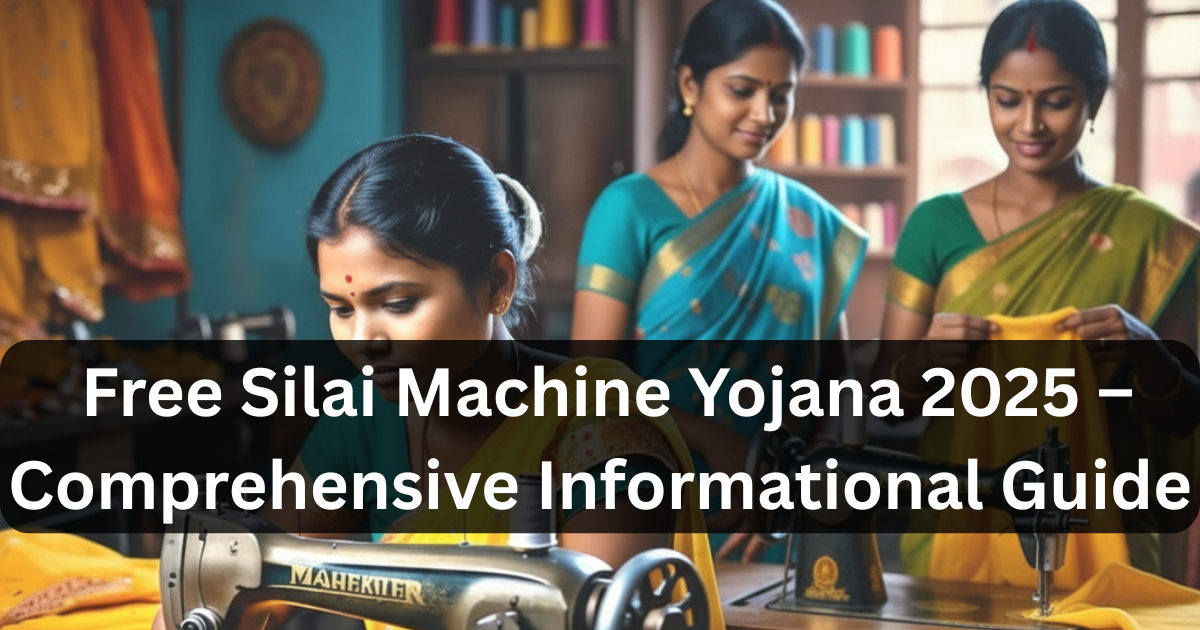
The Free Silai Machine Yojana (also referred to as Free Sewing Machine Scheme) for 2025 is a welfare initiative aimed at enabling women and tailor artisans to become self-employed by providing free or subsidised sewing machines. The scheme is part of broader initiatives such as the Pradhan Mantri Vishwakarma Kaushal Samman Yojana (PMVKSY) for artisans, which is implemented by the Ministry of Micro, Small & Medium Enterprises (MSME). Wikipedia+2pmvishwakarma.gov.in+2
Under this scheme, eligible beneficiaries receive either a sewing machine directly or financial assistance/subsidy to purchase one, along with training and support. The objective is to promote skill enhancement, self-employment, home-based enterprise, and women empowerment. For example, one publication notes that 50,000 women in each state are proposed to get free machines. Unacademy+1
In this article, we provide a comprehensive, structured overview of the Free Silai Machine Yojana 2025: its objectives, components, eligibility criteria, benefits, detailed application process (online & offline), required documents, progress data, key challenges, future goals, frequently asked questions (FAQs) and a conclusion. This write-up is purely informational, formal in tone, and suitable for SEO and AdSense compliance.
Objectives of the Scheme
The major objectives of the Free Silai Machine Yojana 2025 include:
- To enable women (especially from economically weaker sections, widows, single mothers, artisans) to start self-employment opportunities from home by providing a sewing machine or financial assistance to procure one.
- To promote skill development in tailoring/stitching so that beneficiaries can convert the asset into income-generating activity.
- To foster women’s economic empowerment, help them contribute to household income and reduce dependency.
- To boost small-scale micro enterprises in the textile/tailoring sector, including rural and urban households, thereby generating employment locally.
- To integrate traditional tailoring skills with modern self-employment frameworks, thereby sustaining livelihoods and making informal work more formalised.
- To support the goals of home-based work, women entrepreneurship, and the broader “at-home business” model, thus addressing unemployment/migration pressures.
- To help artisans and tailors upgrade their tool-kit, adopt better machines (including “Made in India” machines), and improve productivity and quality of work. For example, one article notes local sewing machine industry expected boost from this scheme. The Tribune
By meeting these objectives, the scheme contributes towards inclusive growth, women’s empowerment, skill India, self-employment and decentralised development.
Components / Key Features
Although implementation may vary across states and central-line guidelines, the main components of the Free Silai Machine Yojana 2025 include:
- Machine Provision / Financial Assistance
- Beneficiaries receive a sewing machine free of cost or financial assistance/subsidy (for example up to ₹ 15,000 in some versions) to purchase one. PM Vishwakarma Yojana+1
- The scheme may ensure machines are locally manufactured/“Made in India” to boost domestic industry. The Tribune
- Training & Skill Development
- Beneficiaries may be required to undergo tailoring/stitching training (5 to 15 days, or more) before or during machine provision, to ensure effective use of the machine. PM Vishwakarma Yojana+1
- Some states/variants may provide stipends during training or linkage to further skill modules.
- Target Beneficiary Selection
- Focus on women tailors, home-based workers, artisans, widows, persons with disabilities, women from SC/ST/OBC/welfare categories. examfinder.in
- Many variants emphasise rural women and economically weaker households.
- Marketing / Enterprise Linkages
- To maximise impact, the scheme may link beneficiaries to local markets, value-chain support, cluster approach, or micro-enterprises for tailoring services. Although not always formalised in every state version, this is a recommended component.
- Under PMVKSY, tool-kits including machinery and marketing assistance are part of the artisan support. Wikipedia
- Monitoring & Implementation Infrastructure
- The scheme is implemented via state/district women & child development departments, MSME/handloom/industry departments, common service centres (CSCs) and partner agencies (e.g., NGOs, artisan cooperatives).
- Online/portal-based registration forms, beneficiary lists, tracking, dashboards may be used. For example, service listed via services.india.gov.in. National Government Services Portal
- Maintenance / Upgrade / Sustainability
- Some versions may incorporate follow-up support, maintenance of machines, refresher training or periodic upgrades to ensure the machine remains usable and productive.
Together, these components form a framework where asset (machine) + skill (training) + enterprise (enterprise opportunity) + support (linkages/market) = effective self-employment outcome.
Eligibility Criteria
Eligibility criteria differ somewhat across states and scheme variants. Below is a general outline and typical conditions for Free Silai Machine Yojana 2025:
Typical Eligibility Conditions
- The applicant must be an Indian citizen and resident of the state/locality where the scheme is offered.
- The applicant is typically a woman (though some schemes may allow male tailors/artisans) often aged between 18-40 years or 20-40 years. examfinder.in+1
- Household/family annual income limit is imposed (e.g., under ₹ 2.5 lakh or as per state/variant) to target economically weaker sections. examfinder.in+1
- Applicant should not have previously benefited from a similar free machine scheme (in many cases).
- Priority is given to widows, divorced women, single mothers, women with disability, SC/ST/OBC categories, rural women and home-based workers. examfinder.in+1
- Applicant must be engaged or willing to engage in tailoring/stitching work and may have a minimum experience in tailoring (varies).
- The beneficiary should have valid Aadhaar, bank account, mobile number, and other state-specific documentation.
Example Variants
- Under one version: age between 20-40 years, husband’s income ≤ ₹ 1.44 lakh per annum for women. PM Vishwakarma Yojana
- In state version in Maharashtra: The Form for “विभिन्न सामग्री पुरविणे या योजनेंतर्गत शिलाई मशीन” (provision of sewing machines under materials supply scheme) is for rural women from scheduled categories. ZP Jalna
Because states may customise criteria (age, income, category, number of machines), applicants should verify their local scheme notification.
Benefits
The benefits of participating in Free Silai Machine Yojana 2025 are both direct and indirect for the beneficiaries, families and communities.
Direct Benefits
- The primary benefit is that eligible beneficiaries receive a free sewing machine or financial assistance/subsidy to procure one (for example up to ₹ 15,000 under some versions). PM Vishwakarma Yojana
- Access to training in tailoring/stitching, enhancing skills and enabling income generation.
- Possibility of undertaking home-based enterprise: tailoring services, stitching units, small-scale production of garments, etc.
- Improved income-earning ability, leading to better financial stability for beneficiary women and families.
Indirect / Wider Benefits
- Empowerment of women: greater autonomy, dignity, recognition of their work, participation in economic activity.
- Generation of employment/self-employment at household level, reducing migration and reliance on external job markets.
- Stimulating local economies: tailors servicing local demand, generating value in rural/urban communities.
- Supporting MSME / artisan / home-based industry ecosystem.
- Enhancement of skills in traditional trades (tailoring) and upgrading equipment/tools (modern sewing machines).
- Potential boosting of domestic sewing machine industry (when machines are sourced locally). As noted for the machine manufacturing cluster in Ludhiana, the scheme is expected to provide orders to local industry. The Tribune
In sum, the Free Silai Machine Yojana is intended to transform an asset (sewing machine) into a sustainable livelihood, skill pathway and vehicle for women’s economic participation.
Application Process
Here’s the step-by-step application process for the Free Silai Machine Yojana 2025, covering online and offline modes. Exact steps may slightly vary by state/local implementing agency.
Online Application
- Visit the official scheme website/portal of the relevant department – e.g., the PMVKSY portal: https://pmvishwakarma.gov.in/ pmvishwakarma.gov.in
- On the portal locate the “Free Silai Machine Scheme / Sewing Machine Scheme” section or application link.
- Register using Aadhaar-linked mobile number, bank account details, create login (if required).
- Fill the application form: personal details (name, age, gender), contact details, address, category (SC/ST/OBC), income details, tailoring experience (if required), bank account, Aadhaar, etc.
- Upload scanned documents: Aadhaar, passport-size photo, income certificate, category certificate, tailoring certificate (if needed), bank passbook copy, etc. (see document list below) hunview.com+1
- Submit the application form. Save/print the registration/reference number for tracking.
- Authorities verify the application, perform eligibility checks, may call for training, inspection of home-unit or tailoring status.
- Once approved, beneficiary is notified (via SMS/email) and machine or assistance is provided/disbursed; training may be scheduled.
- Beneficiary may be asked to submit reports of machine usage, business set-up, etc.
- Sometimes the portal allows tracking of application status or inclusion in beneficiary list.
Offline Application
- Visit the nearest Common Service Centre (CSC), District Women & Child Development Office, Textile/Tailoring Department, or the implementing agency (as per state notification).
- Collect the physical application form for Free Silai Machine Yojana or variant. For example, in Maharashtra the “application form for sewing machine under the scheme to provide various materials to rural women” is downloadable and submitable. ZP Jalna
- Fill the form with required details and attach self-attested copies of documents (Aadhaar, income certificate, photo, bank account, tailoring experience certificate etc).
- Submit the form to the designated office/agency. Obtain acknowledgement receipt/reference number.
- The agency verifies the application, may conduct home-visit, verify tailoring work, etc. Training may be scheduled.
- On approval, sewing machine or assistance is disbursed; beneficiary picks up machine or receives voucher/fund.
- Follow-up with training, usage monitoring, and any linked enterprise orientation.
Important Tips for Applicants
- Ensure your Aadhaar is linked with your bank account and mobile number for smooth verification.
- Collect and keep photocopies/scans of all documents; ensure they are valid and recent.
- If your state version requires tailoring experience or training, keep certificates ready.
- Monitor application status online or via CSC/local office; keep your reference number safe.
- Use machine effectively: set up tailoring work at home or small unit; make business plan; consider clustering with other women tailors for better market access.
- Report usage as required to ensure you remain eligible for future support/maintenance.
Documents Required
The list of required documents varies by state and scheme variant. The following is a general list of documents required for Free Silai Machine Yojana 2025:
- Aadhaar Card (or Aadhaar enrolment number) of applicant. hunview.com+1
- Passport-size photograph of applicant.
- Age proof (Birth certificate or school certificate) to ensure age falls in specified range (e.g., 18-40 years). hunview.com
- Income certificate of applicant/household (issued by competent authority) to verify that income falls under specified limit. examfinder.in
- Caste certificate (if applicable – SC/ST/OBC) and/or widow certificate if applicable. examfinder.in
- Bank account passbook copy or cancelled cheque in the name of applicant (for benefit disbursement).
- Mobile number and e-mail ID (for communication/OTP).
- Tailoring experience certificate or proof of interest/engagement in tailoring (if scheme variant requires).
- Disability certificate (if applicable).
- Application form (online submission or offline physical form) duly filled.
- Any other state/local document as specified in the scheme notification (e.g., domicile/residence certificate, BPL certificate).
Applicants should refer to their state’s implementing department’s notification to ensure they include all required documents and meet local conditions.
Progress Data & Implementation Status
Obtaining detailed national-level numbers for the Free Silai Machine Yojana 2025 is challenging, as data is often dispersed across state portals, scheme summaries and news articles. However some indicative information is available:
- According to an article in The Tribune, under “PM Silai Machine Yojana” in 2025, 50,000 women in each state are to receive free sewing machines. The Tribune
- Some online informational portals note deployment of the Free Sewing Machine Scheme 2024/2025 across states with application forms open and training modules being activated. examfinder.in+1
- At the national portal level (service listing), “Sewing Machine Scheme (HBOCWWB)” lists financial assistance of ₹ 4,500 to registered women construction workers for purchasing a sewing machine. myScheme
- At state level: in Maharashtra, the rural women materials scheme application form document indicates that in financial year 2024-2025 rural women from scheduled categories can apply for a sewing machine under the “विभिन्न सामग्री पुरविणे या योजनेंतर्गत” scheme. ZP Jalna
While these data points show active implementation, key gaps remain: publicised data on number of machines distributed so far, number of applications, states covered, funds disbursed, and impact assessment are not consistently detailed. For stronger transparency, state/central monitoring reports should publish updated dashboards of beneficiaries, amounts, training completion rates and income outcomes.
Challenges and Issues
Despite its positive intentions, the Free Silai Machine Yojana 2025 faces several implementation challenges and issues that need to be acknowledged:
- Awareness and Outreach: Many eligible women (especially in remote rural areas) may not be fully aware of the scheme, application deadlines, eligibility criteria or how to apply. This may lead to under-utilisation.
- Tailoring Skill/Experience Gap: While machines are provided, some beneficiaries may not have prior tailoring/stitching skills, and short training may not fully fill the gap. Without sufficient skill, the machine may not translate into income.
- Market Linkages: Simply giving a sewing machine does not automatically guarantee orders, customers or sustained business. Without access to markets, contracts (uniforms, stitching shops), or marketing support, many machines may remain idle.
- Maintenance & Upgrading: Machines could break down or become obsolete; without maintenance support or upgrade cycle, the long-term sustainability of the enterprise may be limited.
- Verification & Selection Delays: Application verification, training scheduling, machine procurement and distribution may face logistic delays; such delays reduce the timely benefit to the women.
- Equity and Inclusion: Some criteria (age, income threshold, training requirement) may exclude certain women (older than 40, not having prior tailoring experience, or whose family income slightly exceeds the cap). Also, migrant women, women in informal/unregistered sector may face barriers.
- Monitoring & Outcome Metrics: Lack of published impact data (income increase, business sustainment, number of machines actively used) makes it hard to assess the scheme’s effectiveness.
- State-wise Variation: Since implementation is via state agencies, criteria, benefit amounts, training requirement and process vary widely, causing confusion and inequity.
- Digital Divide: Online application may exclude women without internet access, digital literacy or mobile phones; offline infrastructure may be weak in some localities.
- Dependence on Subsidy Model: If beneficiaries treat the machine as a one-time gift and lack business mindset or support to scale, the enterprise may stay micro-level and may not significantly uplift the household income.
Addressing these issues is crucial for converting the scheme from asset provision to sustained livelihood improvement.
Future Goals and Way Forward
To further strengthen the Free Silai Machine Yojana 2025 and maximise its impact, the following goals and strategic directions are suggested:
- Improve awareness and outreach campaigns: Use local women’s groups, SHGs, rural self-help groups, NGOs, panchayats to ensure eligible women know about the scheme and how to apply.
- Provide comprehensive training modules: Beyond basic tailoring, include modules on business planning, market access, digital marketing, design trends, quality standards. This enhances capacity to run a micro-enterprise rather than just operate a machine.
- Ensure market-linkage support: Partner with local garment/residential orders, stitching clusters, school uniform contracts, e-commerce platforms so that the machines have orders and income streams.
- Maintenance-and-upgrade support: Establish after-sales service, repair centres, consumable supply (threads, fabrics, attachments) and plan for future upgrade cycles so machines remain productive.
- Tracking and monitoring with impact metrics: Mandate periodic data collection – number of active users, average monthly income, business sustainability, machine idle rates – and publish state‐wise dashboards for accountability.
- Harmonise criteria across states / portability: While local adaptation is required, adopting a common benchmark for age, income, training and benefit amounts will reduce confusion and ensure equity.
- Encourage clustering and peer networks: Foster women tailors forming groups/cooperatives to share orders, bulk raw-material purchase, common branding and cross-help, thereby achieving economies of scale.
- Link with other schemes: Integrate with SHG credit, PM Vishwakarma loans, skill missions, digital literacy programmes so that the sewing machine becomes a node in a broader livelihood ecosystem.
- Promote digital stitching and value-addition: Encourage beneficiaries to tap into newer work domains: online stitching orders, home-boutique business, customised tailoring, digital templates, which will increase income potential and durability of the enterprise.
- Expand coverage and scale sustainably: Increase the number of machines/beneficiaries while ensuring quality of implementation, training, monitoring and follow-up so that the scheme’s scale does not compromise effectiveness.
By adopting these directions, the Free Silai Machine Yojana can shift from a welfare-asset model to a true livelihood-transformation model – enabling women to build sustainable home-based businesses, contributing to local economies and securing incomes.
Frequently Asked Questions (FAQs)
Q1. What is the Free Silai Machine Yojana 2025?
A: It is a government-welfare initiative (often under the umbrella of the Pradhan Mantri Vishwakarma Yojana) aiming to provide free sewing machines or financial assistance for machines to eligible women/artisans so they can start tailoring work from home and become self-employed. PM Vishwakarma Yojana+1
Q2. Who is eligible to apply?
A: Women (often aged between 18-40 or 20-40 years) from economically weaker households, widows, single mothers, women tailors/artisans, from SC/ST/OBC or rural communities, income below specified limit, valid Aadhaar & bank account. (Specifics vary by state). examfinder.in+1
Q3. What benefit does the scheme provide?
A: Beneficiaries receive a free sewing machine or subsidy/financial assistance (for example up to ₹ 15,000) to purchase one, plus training in tailoring, support to start home-based business, and possibly marketing/training support. PM Vishwakarma Yojana+1
Q4. How can I apply?
A: You can apply online via the official scheme portal (for example pmvishwakarma.gov.in) or offline through the local CSC/women & child development office/district department. Fill the form, attach documents, submit, wait for verification and machine issuance. See application process section above.
Q5. What documents are required?
A: Common required documents include Aadhaar card, age proof, income certificate, bank account details, passport-size photo, tailoring experience certificate (if required), caste/widow/disability certificate (if applicable). See documents section above. hunview.com+1
Q6. Is the scheme only for women in rural areas?
A: While many versions prioritise rural women, the scheme is applicable to both rural and urban women in many states. The key is eligibility criteria (income, tailoring engagement, etc). Unacademy
Q7. Do I need to pay anything to get the sewing machine?
A: No registration or processing fee is typically required. The machine or subsidy is provided free of cost or at a highly subsidised rate, as per scheme rules. examfinder.in
Q8. After receiving the machine, what happens?
A: After receipt, you must start/work in tailoring or stitching at home (or small unit), attend training (if required), maintain necessary records, and possibly report about usage or income to the implementing agency. Over time you may upgrade or link with markets.
Q9. Can men apply under this scheme?
A: Some versions are exclusively for women; others (especially artisan-tailoring/trader categories) may allow male artisans. Applicants should check their state-specific notification.
Q10. How can I check my application status or beneficiary list?
A: You can use your application/reference number on the official portal, log in with credentials or Aadhaar/mobile to check status; alternatively local office/CSC may have beneficiary lists or notify selected names via SMS/notice boards.
Conclusion
The Free Silai Machine Yojana 2025 offers a meaningful opportunity for women, artisans and micro-entrepreneurs to access a tangible asset (a sewing machine) combined with training, support and enterprise potential. This scheme aligns with national goals of women’s empowerment, skill development, self-employment, and inclusive growth.
However, the success of this scheme will depend not merely on the number of machines distributed but on sustained support: delivering effective training, linking beneficiaries with markets, ensuring machines are maintained, and monitoring outcomes (income, business continuity, improvement in livelihoods). It is imperative that implementing agencies focus on outcome metrics, not just asset delivery, to ensure real impact.
If you are eligible or know someone who might qualify, it is recommended to check the official scheme website (for example https://pmvishwakarma.gov.in/) or your local women & child development/women entrepreneurship department, gather the documents, and apply within the announced timeline. By participating fully—with training, enterprise mindset, market linkages—you can convert this asset into a sustainable income-earning activity.
In summary: the Free Silai Machine Yojana is more than just a sewing machine—it can be a stepping stone to self-reliance, women’s economic empowerment and enterprise from home. With proper use, support and follow-through, it carries the potential to positively transform lives.
Official Links for Reference
- PM Vishwakarma Official Portal: https://pmvishwakarma.gov.in/ pmvishwakarma.gov.in
- National Government Services Portal (service listing): https://services.india.gov.in/service/search?kw=Silai+machine+yojana&ln=en National Government Services Portal
- Scheme info pages (e.g., Free Sewing Machine Scheme 2025) via Examfinder: https://examfinder.in/free-sewing-machine-scheme-silai-machine-scheme/ examfinder.in
