
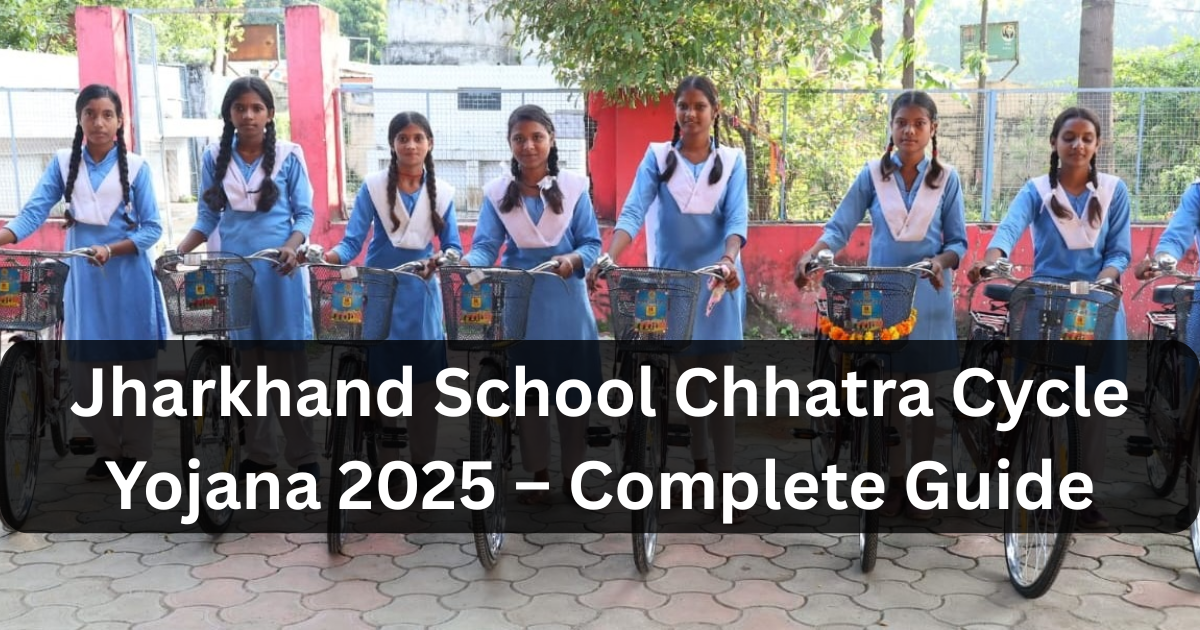
The Jharkhand School Chhatra Cycle Yojana 2025 is a welfare initiative by the Government of Jharkhand aimed at supporting school-going students—especially those studying in government schools and from socio-economically disadvantaged backgrounds—by providing financial assistance for purchasing a bicycle. The key aim is to reduce drop-outs caused by long travel distances to school and thereby improve attendance, retention and access to education. govtschemehindi.com+2Google Translate+2
Under this scheme, eligible students receive a fixed amount (e.g., ₹ 4,500) credited to their bank accounts, which can be used to buy a bicycle. According to published sources, approximately 9 lakh students are expected to benefit in 2025. Google Translate
In this article, we provide a detailed, structured overview of the Jharkhand School Chhatra Cycle Yojana 2025: its objectives, components, eligibility criteria, benefits, application process (online & offline), required documents, progress & implementation status, challenges, future goals, frequently asked questions (FAQs) and a conclusion. The tone is purely informational and formal, suitable for education and policy reference.
Objectives of the Scheme
The main objectives of the Jharkhand School Chhatra Cycle Yojana 2025 include:
- Improve access to schooling: Many students in Jharkhand, especially in rural and remote areas, walk long distances to attend school. By enabling them to use a bicycle, the scheme seeks to ease commuting and thus reduce absenteeism and drop-outs. govtschemehindi.com+1
- Promote attendance and retention: The scheme seeks to incentivise continuing in school by providing physical mobility support, thereby addressing both accessibility and motivation factors.
- Support disadvantaged students: Particularly students belonging to Scheduled Castes (SC), Scheduled Tribes (ST), Other Backward Classes (OBC), minority communities who may face greater travel and economic barriers. Google Translate
- Encourage educational equity: By reducing the travel-related burden on students living far from school, the scheme helps bridge rural-urban or remote-area educational gaps.
- Strengthen educational infrastructure indirectly: While the scheme does not build infrastructure, it addresses a key enabling factor (mobility) that supports the broader goal of school participation and achievement.
These objectives align with the broader state priorities of improving school enrolment, reducing drop-out rates and promoting inclusive education in Jharkhand.
Components / Key Features
The scheme is structured around several components which define how the assistance is delivered, how beneficiaries are selected, and how monitoring is done. Key features are:
- Financial assistance via Direct Benefit Transfer (DBT): Instead of distributing bicycles physically in all cases, the scheme transfers an amount (₹ 4,500 as per latest sources) directly into the bank accounts of eligible students, who can then purchase a bicycle. Google Translate+1
- Eligible class and schools: The assistance is aimed primarily at students studying in class 8 (or sometimes lower/higher, depending on notification) in government schools in Jharkhand. govtschemehindi.com+1
- Target number of beneficiaries: The scheme is designed to benefit approximately 9 lakh students (for the 2025 iteration) across the state. Google Translate
- No separate application (in some variants): Many sources state that the school administration compiles eligible students’ information, and directly forwards to the department; minimal separate application by the student is required. govtschemehindi.com
- Monitoring and list publication: The departmental infrastructure through the Tribal Welfare/School Education Department monitors beneficiary lists, transactions via DBT, and publishes lists/district-wise data. Shramadhan
- Focus on travel-distance and persistence in schooling: The underlying operational design privileges students who may otherwise drop out due to travel constraints, thereby linking the scheme with retention goals.
These components together help operationalise the scheme, making it more than just an offer of a bicycle but part of an accessibility-and-inclusion strategy.
Eligibility Criteria
Eligibility for the Jharkhand School Chhatra Cycle Yojana 2025 is defined by several parameters. While exact criteria may vary slightly by notification, the widely reported conditions are as follows:
- The applicant must be a resident of Jharkhand and studying in a government school in the state. govtschemehindi.com+1
- The applicant must be studying class 8 (in many versions) in a government school. govtschemehindi.com
- The applicant should belong to SC/ST, OBC (backward classes), or minority community (depending on variant) and may have the condition of being from a certain travel-distance cohort. Google Translate+1
- The applicant must have a bank account linked (and presumably Aadhaar), since the assistance is credited via bank transfer. Google Translate
- In some descriptions the scheme emphasises that students are those who face travel burdens (e.g., living at a certain distance from school). While not always clearly stated, the scheme design refers to distance from school as an underlying rationale. govtschemehindi.com
- The scheme applies to students studying in government schools—private school students may not be eligible under the standard version. govtschemehindi.com
It is recommended that applicants check the latest official notification published by the Jharkhand government’s School Education or Tribal Welfare Department to confirm any year-specific modifications, eligibility ceilings or added categories.
Benefits of the Scheme
The benefits emerging from the scheme can be grouped into direct and indirect advantages for the students, families and the state educational ecosystem.
Direct Benefits
- The primary benefit is the financial assistance of ₹ 4,500 (as reported for 2025) credited to the eligible student’s bank account for purchasing a bicycle. govtschemehindi.com+1
- Improved commuting to school: With a bicycle, the student can cover longer distances more easily, reducing late attendance, transport fatigue and drop-out risk.
- Encouragement for regular attendance: The scheme acts as an incentive for students and families to invest in school attendance, retention and progression.
Indirect / Broader Benefits
- Enhanced educational access in remote/rural areas: By alleviating travel constraints, the scheme helps ensure that schooling remains accessible even for students far from school.
- Potential improvement in educational outcomes: Better attendance and reduced drop-outs may contribute to higher achievement, completion of secondary education and better transition to further stages.
- Social equity: By targeting disadvantaged groups (SC/ST/OBC/minorities), the scheme advances inclusive education and helps reduce inequality in access.
- Economic benefit to families: Reduced transport cost/time burden, increased likelihood that children stay in school rather than dropping out to support home/farm work.
- Positive signal for education policy: Demonstrates state commitment to addressing access barriers, and may strengthen community trust and engagement in schooling.
Thus, the scheme is both a tangible benefit (money for bicycle) and a policy lever in improving school retention and reducing distance-related travel barriers.
Application Process
Below is a step-by-step outline of how the application process works for the Jharkhand School Chhatra Cycle Yojana 2025, for both online and offline modes, as per available information.
Offline / School-Managed Process
- The student attends a government school in Jharkhand and falls under the eligible class (Class 8) and category (SC/ST/OBC/minority).
- The school administration issues an internal checklist/notification to students in the eligible cohort and collects necessary details: bank account number, Aadhaar, caste certificate, etc.
- The school compiles the list of eligible students and sends it to the district or state‐level implementing department (School Education Department, Tribal Welfare, etc.). govtschemehindi.com
- The department verifies details (student identity, school enrolment, bank account linked, category certificate) and prepares beneficiary list.
- The approved students receive the assistance of ₹ 4,500 via Direct Benefit Transfer (DBT) into their bank accounts. Google Translate
- The student uses the funds to purchase a bicycle and in some cases may be required to submit the bill/receipt to school/district for records. govtschemehindi.com
- The school/district monitors distribution and may compile data on usage, attendance improvement, etc.
Online / Portal Process
While the scheme is largely operated via school/district mechanisms, some portal linkages exist (e.g., via the state scheme portal or the national MyScheme portal). For example, the scheme is listed under the MyScheme portal. myScheme
Steps for online registration (if applicable) typically include:
- Student/School logs into designated portal for the scheme.
- Enter student details: name, Aadhaar number, bank account, school roll number, caste category, class and school information.
- Upload required documents (Aadhaar, bank passbook copy, caste certificate, school enrolment certificate).
- Submit the application; receive reference/registration number.
- Wait for verification; if approved, funds are transferred via DBT.
- After transfer, student may purchase bicycle and upload proof/receipt if required for monitoring.
Important Tips for Applicants
- Ensure bank account is in your name, and Aadhaar is linked to bank account to facilitate DBT.
- Keep school enrolment certificates, bank passbook, caste certificate, Aadhaar card ready for verification.
- Respond promptly to any school/district request for data or signed form.
- Monitor school notice board or district education office for lists of approved beneficiaries.
- After receiving funds, purchase the bicycle and maintain/retain the invoice/bill for records.
- Attend any orientation/training or meetings if organised by school/district for beneficiaries.
Documents Required
The students applying under the scheme (or whose school applies on their behalf) must provide the following typical documents:
- Aadhaar Card of the student.
- Bank account passbook copy/cancelled cheque with the student’s name (for DBT).
- Class enrolment certificate or school identity card showing that the student is studying in Class 8 (or other eligible class) in a government school.
- Caste certificate (SC/ST/OBC) or minority community certificate, as per eligibility category.
- Proof of residence/domicile in Jharkhand (if required).
- Passport-size photograph of the student.
- School mark sheet or last class document (if required by state for verification).
- Any other document requested by the school/district (e.g., mobile number, parent/guardian Aadhaar, travel distance certificate).
Applicants should check with their school or district education office for the exact list under the current year’s notification.
Progress Data & Implementation Status
While state-wide comprehensive data is limited in the public domain, the following information provides insights into the scheme’s progress and status:
- According to a 2025 update, the scheme is estimated to benefit about 9 lakh students in Jharkhand. Google Translate+1
- The scheme is listed on the MyScheme portal as “Cycle Sahayata Yojana (साइकिल सहायता योजना)”, indicating official recognition and listing under the state’s welfare scheme inventory. myScheme
- District-wise data is published on the Jharkhand scheme MIS portal for the “Cycle Sahayata Yojana” (Scheme ID 28). For example, data for districts such as Chatra, Deoghar etc. appear under the scheme listing. Shramadhan
- The 2024/2025 version emphasises DBT transfer by December for the current academic year. govtschemehindi.com
Despite these indicators, gaps remain: many public outlets are summarised news-articles or blog posts rather than official reports, and details such as actual number of funds disbursed, actual bicycle purchases, subsequent impact on attendance/drop-outs are not widely published.
For full transparency and monitoring, the state government may consider publishing annual reports with metrics: number of applications, number approved, funds transferred, recordings of bicycle purchases, change in distance/time to school, and attendance/drop-out rates among beneficiaries versus non-beneficiaries.
Challenges and Issues
Implementation of such schemes often faces practical challenges. Some of the challenges specific to the Jharkhand School Chhatra Cycle Yojana include:
- Identification of truly needy students: While eligibility is defined, ensuring that students who genuinely travel long distances or face drop-out risk are captured requires robust data and verification.
- Distance and terrain challenges: In hilly or remote regions of Jharkhand, even a bicycle may not fully address commuting difficulty; additional support (safe route, maintenance) may be needed.
- Timely fund transfer and procurement delays: Delay in DBT transfer or bureaucratic lag may mean students get assistance late in the academic year, reducing the intended benefit.
- Use of funds and safe purchase: Once funds are transferred, students or families need to safely purchase good quality bicycles; price variability, availability, local markets may pose issues.
- Maintenance and safety of bicycles: After purchase, bicycle wear/tear, maintenance costs, safe parking/storage at school/home are matters that may affect continued usage.
- Integration with other support systems: The bare provision of funds may not ensure improved attendance or academic outcomes; integration with transportation, mentoring, attendance monitoring is needed.
- Data transparency and monitoring: The scarcity of detailed, official impact data makes it difficult to assess actual reach and outcomes of the scheme.
- Awareness among students/families: Students or families may not be aware of the scheme or how the funds will be used, or may distrust the procedure, resulting in non-uptake or misuse.
- Access issues for migrant or marginal students: Students from marginalized communities, nomadic families, or migrant families may face difficulties fulfilling documentation requirements or being captured by the list.
Addressing these operational issues is important for converting the scheme from a policy promise to meaningful outcome for students.
Future Goals and Way Forward
To enhance the impact of the scheme and ensure sustainable benefits, the following future goals and recommended directions are suggested:
- Increase outreach and awareness: Ensure all eligible students—especially those in remote tribal/forest areas, migrant households and disadvantaged groups—are aware of the scheme and how to benefit.
- Better monitoring and evaluation: Publish state-district level dashboards showing applications, approvals, funds transferred, bicycle purchase evidence, and link with indicators such as attendance/drop-out reduction.
- Complementary infrastructure support: Beyond providing the bicycle, ensure safe routes, cycle parking at school, maintenance services and periodic check-ups so that bicycles are safe and long-lasting.
- Link with attendance/achievement incentives: Use the bicycle scheme as part of a broader student retention package—monitoring attendance, providing mentoring, reducing drop-out risk, especially after class 8.
- Quality and local procurement: Encourage purchase of good quality bicycles; consider framing preferential buying programmes or multi-year maintenance partnerships to ensure durability.
- Target expansion/inclusion: Consider expanding the scheme to students in classes beyond 8th (e.g., class 9/10) or to private school students from disadvantaged backgrounds, depending on budget and impact.
- Sustainability of benefits: Build into the scheme periodic review of usage, maintenance record, condition of bicycles and follow-up with beneficiaries so that the asset continues to serve.
- Integrate with other educational-mobility schemes: For instance, linking bicycle assistance with school bus/transport systems, scholarship programmes, digital learning kits so that mobility is part of a comprehensive student support framework.
- Community and school-level ownership: Involve Parent-Teacher Associations (PTAs), student councils, local NGOs/SHGs for monitoring usage, creating awareness, and ensuring fair distribution.
- Scale-up and replication: Based on pilot results, scale the scheme across all blocks/districts with high travel-distance burden, and replicate best practices in other educational support initiatives.
These directions will help the scheme evolve from a single-benefit measure to a sustainable enabler of educational access and equity.
Frequently Asked Questions (FAQs)
Q1. What is the Jharkhand School Chhatra Cycle Yojana 2025?
A: It is a scheme by the Government of Jharkhand to provide financial assistance (₹ 4,500) to eligible students (in class 8, in government schools, belonging to disadvantaged communities) so that they can purchase a bicycle for commuting to school. Google Translate+1
Q2. Who is eligible to benefit from this scheme?
A: Students of Jharkhand resident, studying in a government school (generally in class 8), belonging to SC/ST/OBC/minority categories, with a bank account linked, are eligible. Applicants must meet the current year’s notification criteria. govtschemehindi.com+1
Q3. How much assistance is provided under the scheme?
A: As per 2025 reports, the amount is ₹ 4,500 credited to the student’s bank account for bicycle purchase. Google Translate+1
Q4. How many students will benefit in 2025?
A: The scheme aims to benefit approximately 9 lakh students in the state in 2025. Google Translate
Q5. How do I apply for the scheme?
A: The school administration usually compiles and forwards eligible students’ data to the district/state department; in many cases no separate application is needed. Students must ensure their bank account and documents are verified by the school. govtschemehindi.com
Q6. What documents are required for the scheme?
A: Documents typically include Aadhaar card, bank passbook, caste certificate, school enrolment certificate (class 8), and possibly residence/domicile proof. Schools may collect these on behalf of students.
Q7. When will the funds be transferred?
A: According to available information, the amount is expected to be transferred by December of the academic year in many cases, enabling students to purchase the bicycle ahead of the next term. govtschemehindi.com
Q8. Can students of private schools apply under this scheme?
A: Most sources suggest the scheme is targeted at government school students; private school students may not be included unless specified in a notification. Applicants should verify the latest circular.
Q9. Does the scheme guarantee purchase of a specific brand/model of bicycle?
A: The scheme provides a financial amount (₹ 4,500) and the student/family purchases the bicycle. Quality and model selection are typically left to the beneficiary subject to school/district verification of purchase.
Q10. What happens if my bank account is not linked or details are incorrect?
A: A non-linked account or incorrect bank/Aadhaar details may delay or prevent fund transfer. Students should ensure their bank account is in their name, Aadhaar is linked to the account and all details submitted via the school are correct.
Conclusion
The Jharkhand School Chhatra Cycle Yojana 2025 represents a targeted effort by the state government of Jharkhand to address one of the key barriers to schooling—distance/travel-time for students in remote or disadvantaged settings. By providing financial assistance for a bicycle, the scheme aims to enhance access, retention and equity in education.
However, while the scheme has significant promise, its real impact will depend on careful implementation, timely fund disbursement, quality of bicycles purchased, students’ regular use of the asset and monitoring of educational outcomes (attendance improvement, drop-out reduction). The scheme also needs to be embedded into a broader ecosystem of student support (transport facilitation, school-infrastructure, mentoring) to maximise benefits.
If you are a student or parent/guardian in Jharkhand who may be eligible, you should check with your school administration or district education office for the latest notification, ensure that your bank account and Aadhaar linkage is correct, submit/verify required documents and monitor the school’s list of approved beneficiaries.
In short, the scheme is an enabling tool—but its value is realised when the assistance leads to actual bicycle purchase, improved commute, consistent attendance and eventually, better educational outcomes. With sustained support, monitoring and student engagement, the Jharkhand School Chhatra Cycle Yojana has the potential to contribute meaningfully to educational equity in the state.
Official Links for Reference
- Scheme listing on MyScheme portal: https://www.myscheme.gov.in/hi/schemes/csy-j myScheme
- Scheme MIS district-wise listing (Cycle Sahayata Yojana): https://shramadhan.jharkhand.gov.in/SchemeUowMISdistrictwise.action?scheme_id=28&scheme_name=Cycle+Sahayata+Yojana+%28%E0%A4%B8%E0%A4%BE%E0%A4%87%E0%A4%95%E0%A4%BF%E0%A4%B2+%E0%A4%B8%E0%A4%B9%E0%A4%BE%E0%A4%AF%E0%A4%A4%E0%A4%BE+%E0%A4%AF%E0%A5%8B%E0%A4%9C%E0%A4%A8%E0%A4%BE%29 Shramadhan
