
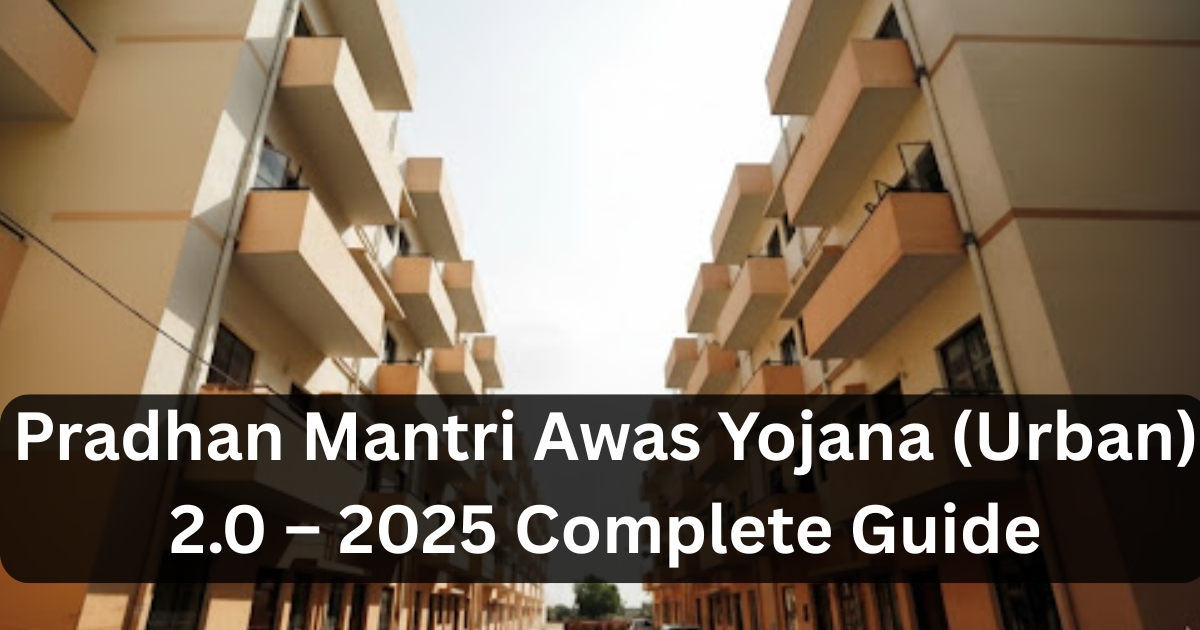
The Pradhan Mantri Awas Yojana (Urban) 2.0 (PMAY-U 2.0) is the next phase of the Indian government’s flagship urban housing scheme aimed at delivering “housing for all” in urban areas. Building on the earlier phase (PMAY-Urban), the 2.0 version is designed for implementation from 1 September 2024 for a period of five years, covering urban households across India who do not have access to a pucca house. PMAY-HFA+3PM Government Scheme Hub+3PMAY-HFA+3
The scheme is administered by the Ministry of Housing & Urban Affairs (MoHUA), Government of India, and is intended to address both quantitative and qualitative aspects of urban housing: ensuring durable, all-weather homes, with basic services and infrastructure, for eligible families in cities and urban local bodies. PMAY-HFA+1
In this article we provide a thorough, structured overview of PMAY-U 2.0: its objectives, components, eligibility criteria, benefits, application processes (online & offline), required documents, progress data to date, challenges, future goals, frequently asked questions (FAQs) and a concluding section. This is purely informational, without marketing claims, and formatted for clarity and SEO-friendliness.
Objectives of PMAY-Urban 2.0
The main objectives of PMAY-U 2.0 are:
- To provide all-weather pucca houses to eligible urban households across India who do not own a pucca house, thus ensuring the goal of “Housing for All” in urban areas. PMAY-HFA+2PMAY-HFA+2
- To ensure that houses are not only constructed, but have basic civic infrastructure such as water supply, sanitation, electricity, roads/sewerage, and are resilient to disasters. PM Government Scheme Hub+1
- To cover all urban local bodies (ULBs), including towns newly notified as statutory towns, thus broadening the coverage compared to earlier phases. PM Government Scheme Hub+1
- To incorporate lessons from the first phase of PMAY-U (which commenced earlier) and to adopt global best practices, use of technology (e.g., GIS/geo-tagging), innovation (e.g., prefabricated/modular housing) and enhanced monitoring. PMAY-HFA
- To focus on inclusive housing: the homes are to be registered preferably in the name of the female head of household or jointly with spouse, and special provisions are included for Persons with Disabilities (Divyangjan) and vulnerable groups. PM Government Scheme Hub+1
- To ensure that the scheme contributes to sustainable urbanisation and improved quality of life for eligible urban citizens.
Components (Verticals) of the Scheme
PMAY-U 2.0 has four major verticals under which assistance is provided. These verticals largely mirror the earlier version but with improved design and focus. PM Government Scheme Hub+1
- Beneficiary Led Construction (BLC)
- Under this vertical, eligible beneficiaries (EWS/LIG/MIG) who own land in urban areas (or have legitimate rights) can construct or enhance a pucca house.
- The central assistance is given per unit and states/UTs manage implementation via ULBs.
- Affordable Housing in Partnership (AHP)
- Collaboration between public sector entities/SLBs/UAs and private sector developers to provide affordable housing units to EWS/LIG households.
- Emphasis on providing serviced plots/units with basic civic amenities.
- Affordable Rental Housing Complexes (ARHCs)
- Addressing rental housing needs of urban migrants / poor / informal sector workers, particularly in industrial hubs and non‐formal urban economies.
- Focus on rental models rather than ownership, thereby catering to an important segment of the urban population. PMAY-Urban
- Interest Subsidy Scheme (ISS) / Credit-Linked Assistance
- Under this vertical, eligible EWS/LIG/MIG households can avail interest subsidy on home loans for purchase/construction of a house in an urban area.
- This vertical especially enables households without any land or with limited resources to access formal financing. Ujjivan Small Finance Bank+1
These four verticals together aim to cover the wide spectrum of urban housing needs – ownership by those with land or existing houses to upgrade; partnerships to scale up; rental solutions; and financing solutions via subsidy.
Eligibility Criteria
To qualify for benefits under PMAY-U 2.0, households must satisfy certain criteria. Key eligibility conditions include:
- The applicant must be a family in an urban area (i.e., residing in a statutory town/urban local body) and must not own a pucca house in any part of India. PMAY-HFA
- The family should fall within one of the income group categories:
- EWS (Economically Weaker Section)
- LIG (Low Income Group)
- MIG (Middle Income Group) HDFC+1
- Income thresholds (indicative) as per some sources: e.g., EWS up to ₹ 3 lakh per annum; LIG up to ₹ 6 lakh; MIG up to ₹ 9 lakh, though states/UTs may have variations/updates. HDFC+1
- The house should be in an urban area covered under the scheme; the land or plot should be eligible as per the state/ULB norms.
- The house/plot should comply with the scheme’s technical specifications (pucca house, all-weather construction, basic infrastructure).
- The house/unit to be registered preferably in the name of the female head of household or jointly with husband. PM Government Scheme Hub
- The scheme period is five years (from 1 Sept 2024 to 2029) and assistance will be given to units approved within the scheme period. Indian Overseas Bank+1
It is important for applicants to check the latest official guidelines and the state‐specific instructions because states/UTs may have additional eligibility details, priority categories, or local modifications.
Benefits of PMAY-U 2.0
Eligible beneficiaries under PMAY-U 2.0 can avail several benefits depending on the vertical under which they apply. Some of the key benefits are:
- Financial assistance from the central government (and matching from state/UT/ULB) to construct or purchase a pucca house in an urban area. For instance, the central assistance per unit is up to ₹ 2.50 lakh (in many cases) under certain components. PMAY-HFA+1
- For the interest subsidy vertical (ISS), eligible households can avail interest subsidy on home loans, thereby reducing the EMI burden and making housing finance affordable. Some banks/financing institutions quote up to ₹ 1.80 lakh subsidy on home loan interest. Ujjivan Small Finance Bank+1
- The houses must have access to basic amenities – water, power, sanitation, roads/sewerage – thus enhancing living standards for urban families. PM Government Scheme Hub
- The housing units and scheme also emphasize sustainability, disaster resilience, and inclusive features (accessibility for persons with disabilities). herohousingfinance.com+1
- Increased ownership and security of housing for urban poor and middle-income groups, improved quality of life, social inclusion, and urban transformation.
- A broadened coverage of cities/towns means that previously excluded urban local bodies may now become eligible, thus increasing reach. PM Government Scheme Hub
Overall, the scheme aims to reduce slums, shift informal housing to formal pucca housing with civic amenities, and move towards inclusive, sustainable urban habitats.
Application Process
Online Application
- Visit the official PMAY-Urban portal: https://pmay-urban.gov.in or https://pmaymis.gov.in/PMAYMIS2_2024/PMAY-urban-2.html PMAY-HFA+1
- On the portal, look for the section “Apply for PMAY-U 2.0” or “Check eligibility / Apply”. iiflhomeloans.com
- Enter required details: Aadhaar number, mobile number, income, address, family details, urban local body etc.
- Select the vertical under which you are applying (BLC/AHP/ARHC/ISS) as per your eligibility and category.
- Upload digital copies of required documents (see next section) and submit the application online.
- After submission, you will receive an application/registration number. The ULB/State nodal agency will process the application and verify eligibility.
- If approved, a sanction letter is issued, and the beneficiary can proceed with construction/purchase/home loan disbursement etc as per scheme norms.
Offline Application
- Approach your local Urban Local Body (ULB), State Housing Mission, or the nodal agency for PMAY-U in your state/UT.
- Obtain a physical application form for PMAY-U 2.0 (often available at ULB office / State Housing Mission / bank branches) or can be downloaded from the official website.
- Fill in the form with necessary details — applicant’s name, address, family details, income, category (EWS/LIG/MIG), declaration of no pucca house, etc.
- Attach self-attested copies of required documents (proof of identity/address, income certificate, Aadhaar, land/plot documents, bank account, etc).
- Submit the filled application to the ULB/State nodal agency/bank as specified in your state.
- The nodal agency will verify the application, conduct eligibility checks, site inspection (if required), and once approved, issue the sanction.
- Upon sanction, beneficiaries can avail the benefits as per scheme vertical – start construction/purchase or avail home loan and subsidy, as applicable.
Important tips for both modes:
- Ensure that your Aadhaar is linked with mobile number and bank account for smoother processing.
- Ensure that the land/plot (if applying under BLC or purchase) is in an urban area and satisfies state/ULB criteria.
- Maintain copies of all submitted and uploaded documents.
- Keep track of your application number and check the portal for status updates.
- State/UT competent authority may conduct site verification, geo-tagging, photograph updates — ensure you cooperate.
Documents Required
The typical list of documents required to apply under PMAY-U 2.0 (depending on vertical) may include:
- Aadhaar card of all adult family members or Aadhaar enrolment number.
- Proof of identity (Voter ID, PAN, Passport, Driving Licence) and proof of address (ration card, utility bills, bank statement)
- Income certificate of the family (issued by competent authority) to show that the household belongs to EWS/LIG/MIG category. HDFC
- Declaration that neither the applicant nor any family member owns a pucca house anywhere in India.
- Bank account details of applicant (for direct benefit transfer) including bank passbook copy or cancelled cheque.
- Land/plot ownership document or legal occupancy certificate (if applying under Beneficiary Led Construction or purchase).
- Application form duly filled in and signed by applicant (and spouse where applicable).
- Passport-size photograph of applicant and family member(s) as per requirement.
- In case of home loan under ISS vertical: loan sanction letter, cost of house/unit, etc.
- Any other state/ULB specific certificate (such as Non-Disposal Certificate of land, Municipal NOC, building plan approval etc) as required by state/ULB.
- For persons with disabilities or other special categories: relevant certificate(s).
- Completion certificate or occupancy certificate (as per state norms) after construction/purchase of unit (for release of final instalment of assistance).
Applicants should refer to state/UT specific guidelines, as different states may ask for additional or modified documents. The scheme guidelines document is available on official portal: PMAY-U 2.0 Guidelines PMAY-Urban
Progress Data & Implementation Status
The Government of India has published sanction and release orders under PMAY-U 2.0 for the financial year 2025-26, across states/UTs. For example:
- Under FY 2025-26, the first instalment of central assistance for several states has been sanctioned (e.g., Uttar Pradesh: ₹ 32,826.00 lakh for 54,710 houses in 220 BLC projects; Maharashtra: ₹ 10,167.00 lakh for 207 BLC projects). PMAY-Urban
- The scheme envisages an investment of ₹ 10 lakh crore (1 trillion) and target of one crore (1 00 lakh) urban families over five years under PMAY-U 2.0. PMAY-HFA
While detailed state‐wise completed units under 2.0-phase are still being updated, the official sanction orders indicate active roll-out across states.
The earlier phase of PMAY-Urban (pre-2.0) achieved large scale: for instance, the scheme portal states that the overall mission is underway and online MIS tracking of approved and completed units is available. PMAY-Urban
This data suggests that the implementation of PMAY-U 2.0 is underway with central assistance being released and states/UTs sanctioning projects. Over the next years the delivery of physical houses/units is expected to pick up pace.
Challenges and Issues
While PMAY-U 2.0 is a laudable initiative, several challenges and issues need to be addressed to ensure effective implementation:
- Land/Plot availability and delivery of serviced sites: Many urban areas struggle with land acquisition, high land cost, regulatory clearances, and infrastructure provisioning. Hence converting land/plot into housing units remains a bottleneck under certain verticals.
- Timely completion of units and quality control: Ensuring that approved houses are built to specification, are durable and weather-resistant, and deliver promised amenities is challenging across different states. Monitoring, geo-tagging, and robust inspection mechanisms need strengthening.
- Financial sustainability and cost escalations: While central assistance is fixed (e.g., up to ₹ 2.50 lakh per unit), actual construction costs may be higher in many urban areas, leading to reliance on beneficiary contribution or state subsidy. Cost escalation may slow delivery.
- Awareness and uptake: Some eligible urban households may not be aware of the scheme or how to apply. Especially in smaller towns/ULBs the outreach may need reinforcement.
- Integration with urban infrastructure and services: Mere housing units do not suffice unless water, sanitation, roads, electricity and connectivity are in place. The coordination between housing and urban local body/civic infrastructure remains key.
- Administrative delays and state/ULB capacity: Implementation requires approval of DPRs, sanctioning projects, fund release, monitoring — states with limited capacity may lag behind.
- Inclusion and targeting: Ensuring that the most deserving households (EWS/LIG) get preference, preventing duplication of benefits, and verifying that beneficiaries indeed do not own pucca houses are ongoing concerns.
- Maintenance and long-term habitability: Post-handover maintenance, common services, housing society management etc can become issues.
- Urban heterogeneity and local variations: India’s urban areas vary widely in cost, land regulation, climate, hazard susceptibility, so adapting a central scheme across all cities/towns is challenging.
Addressing these challenges systematically will be essential for PMAY-U 2.0 to achieve its objectives in time.
Future Goals and Way Forward
Looking ahead, the scheme aims to achieve several goals and undertake advancements:
- Full implementation of the target: delivering housing to one crore urban families over the five-year period. PMAY-HFA
- Expanding the eligible towns/ULBs: including newly notified statutory towns, peri-urban areas, and growth centres. PM Government Scheme Hub
- Emphasising sustainability: use of green/energy-efficient technologies, disaster-resilient construction, balancing affordability with durability. herohousingfinance.com
- Strengthening monitoring & digitalisation: wider use of geo-tagging, satellite imagery, MIS dashboards to enhance transparency and speed of delivery.
- Better integration with other urban schemes: ensuring that housing delivery links with urban infrastructure initiatives (water-supply, sanitation, public transport, smart city programmes).
- Encouraging private sector participation (especially under AHP vertical), innovative construction models (prefabricated/modular), and cost saving techniques.
- Enhancing rental housing options (through ARHCs) so that urban informal workforce and migrants are also catered for.
- State-specific innovations and tailoring: allowing states/UTs to adopt local norms, cost structures, participating agencies, within the overall framework of the scheme.
- Ensuring long-term sustainability: management of housing complexes, maintenance, community ownership, upgradation over time.
- Continuous capacity building: for ULBs, state housing missions, banks/funding agencies, to process applications, sanction, monitor and deliver houses efficiently.
By pursuing these goals, PMAY-U 2.0 aims to not only deliver houses but create integrated, inclusive urban ecosystems that improve lives.
Frequently Asked Questions (FAQs)
Q1. What is PMAY–U 2.0?
A: It is the second phase of the Pradhan Mantri Awas Yojana (Urban) scheme, launched for a five-year period from 1 September 2024, aiming to provide all-weather pucca houses to eligible urban households across India. Indian Overseas Bank
Q2. Who is eligible for PMAY-Urban 2.0?
A: Urban families who do not own a pucca house anywhere in India, falling in the EWS/LIG/MIG income groups, with the house to be constructed/purchased in an urban area covered under the scheme. Income thresholds may vary by state. HDFC+1
Q3. What are the income limits?
A: Indicative income slabs given by some sources: EWS up to ₹ 3 lakh per annum, LIG up to ₹ 6 lakh, MIG up to ₹ 9 lakh. These may vary by state or be revised. HDFC+1
Q4. How much central assistance is provided?
A: Under PMAY-U 2.0, central assistance per unit of house is up to ₹ 2.50 lakh in many cases. PMAY-HFA+1 For the interest subsidy vertical, subsidy of up to about ₹ 1.80 lakh on home loan interest is cited. Ujjivan Small Finance Bank+1
Q5. How do I apply?
A: You can apply online through the PMAY‐Urban portal (pmay-urban.gov.in or pmaymis.gov.in) by registering, filling the form, uploading documents, and submitting. Alternatively, you can apply offline at your local ULB/State nodal office/bank with physical form and documents.
Q6. Can I apply if I already own a house?
A: No. One of the eligibility criteria is that the family does not own a pucca house in any part of India. If you already own a pucca house, your eligibility is likely disqualified.
Q7. What counts as a pucca house?
A: A pucca house is generally one constructed with permanent materials (such as concrete, bricks, permanent roof) and suitable for living in all seasons. The exact definition may vary by state/ULB.
Q8. What happens after approval?
A: After approval/sanction, you will receive central assistance and/or interest subsidy under chosen vertical. For construction/purchase verticals you must complete the unit with required amenities and submit completion certificate. For ISS you must avail home loan and subsidy is applied.
Q9. Are there state/ULB differences?
A: Yes. While central guidelines provide the framework, states/UTs and ULBs may have additional stipulations (income limits, house size, plot eligibility, priority categories) which applicants must check locally.
Q10. What is the deadline for the scheme?
A: The scheme is designed for five years from its start date, i.e., 1 September 2024 to 31 August 2029 (in many references). MagicBricks+1
Conclusion
The Pradhan Mantri Awas Yojana (Urban) 2.0 marks a significant continuation and strengthening of India’s commitment to “Housing for All” in urban areas. With its four verticals (Beneficiary Led Construction, Affordable Housing in Partnership, Affordable Rental Housing Complexes, and Interest Subsidy Scheme), the initiative seeks to address a wide range of urban housing needs — ownership, rental, financing and partnerships.
The scheme offers eligible urban households the opportunity to acquire pucca houses with basic infrastructure, thereby improving their living standards and contributing to inclusive urban transformation. Yet, for the goals to be realised, effective implementation, robust monitoring, state/ULB readiness, infrastructure provisioning and beneficiary awareness are vital.
If you meet the eligibility criteria, you are encouraged to check the official portal and your local ULB/State housing mission to apply. Do review the official guidelines for your state/UT, ensure that all documents are in place, and track your application after submission.
With sustained effort and coordination between the Centre, states/UTs, urban local bodies, financial institutions, developers and citizens, PMAY-U 2.0 can make a meaningful contribution to urban housing in India over the coming years.
Official Links for Reference
- Official PMAY-Urban portal: https://pmay-urban.gov.in PMAY-Urban+2PMAY-HFA+2
- PMAY-U 2.0 Guidelines: https://pmay-urban.gov.in/pmay-u-2.0-guidelines PMAY-Urban
- Eligibility check page: https://pmaymis.gov.in/pmaymis2_2024/PMAY_SURVEY/EligiblityCheck.aspx PMAY-HFA
